Thursday, March 1, 2018

Voice Lessons

Voice Lessons

http://ift.tt/2FfZMBB


Nearly four decades ago, the concept of a “brand voice” captured considerable attention in the marketing community. Today, the concept is widely used by branding professionals, but it is still largely misunderstood and under-leveraged. All too often, brand voice is watered down to a page of overused words— innovative, human, collaborative— that are supposed to drive the tone of all communications. So it’s not surprising that most brand voices are predictable, uninspired, generic and often incoherent. 

An undifferentiated voice is particularly detrimental today as the focus shifts from what brands communicate to how brands communicate. To build a distinctive identity, a brand must develop an instantly recognizable voice that generates strong positive associations and establishes the character of communications whether classic or innovative, glamorous or functional, aristocratic or irreverent, elegant, simple or down-to-earth.

advertisement

advertisement

I have studied hundreds of companies to learn how distinctive voices emerge. The most effective brand voices are generated when powerful visions are passed down to employees and nurtured in environments designed to project purpose, positioning and culture. Vision can spring from many sources: distinctive products, impassioned marketing concepts, the unique perspective of a visionary founder, or a well-defined corporate culture. The starting point is self-knowledge; the organization must clearly define what it does, what it stands for and how to generate supporting behavior from its’ core audiences.

It Has Become Harder To Get It Right

For corporations, political parties, candidates, doctors, or individuals, navigating the complexity of the exploding media landscape is extremely challenging. Brands must deal with massive fragmentation across the proliferation of mobile, social media platforms, pay TV services, etc.

This was driven home in a recent meeting with a media company that was putting together a communications plan repositioning one of the world’s largest public universities. The major portion of a two-hour presentation focused on social media platforms, leaving only 10 minutes to review out-of-home media (TV, newspapers, magazines and radio). The digital and social media strategy covered 12 platforms, reaching audiences from the predictable (Snapchat, Facebook, Twitter and LinkedIn) to obscure sensory-activated sites, and audio.

Voice programs today are usually structured around three or four words that provide direction for the tone of communications programs. A more robust approach to building a voice is needed—fusing purpose, positioning, messaging, customer interaction and visual language. An effective voice addresses not only how you speak but what you say and how you behave.

One cannot emphasize enough the significance of the credo: “clarity above all.” To break through complexity, there is no substitute for simplifying communications and business practices. Now, more than ever, we are challenged to recalibrate voice with the right pitch, tone and volume in an environment where speed, novelty, distraction and noise rule the day.


Social media

via MediaPost.com http://ift.tt/2nAOR8B

March 1, 2018 at 08:26AM

Carl's Jr. Hosting Oscars-Timed Twitter 'Awards Show'

Carl's Jr. Hosting Oscars-Timed Twitter 'Awards Show'

http://ift.tt/2FfZI4P

Carl’s Jr. is hosting its own social media “awards show” leading up to and during the Academy Awards on March 4.

The QSR’s awards — dubbed “The Thickies,” after the its signature Thickburgers — will recognize fans for exceptional tweets in a variety of categories, including Best Fan, Best Tweet, Best Food Review, Best Food Selfie and even Best Hater and Best Competitor.

While any tweets from the past year are eligible for consideration, Carl’s is encouraging fans to post something fresh this week.

The brand is promoting the effort with GIFs and engaging fans on its Twitter account all week. It will announce the winners on Oscars Sunday, in succession, in the same style as an awards show.

Prizes include trophies and $25 Carl’s Jr. gift cards.

Carl’s Jr. is the midst of a brand overhaul — as is Hardee’s, its sibling CKE Restaurant Holdings Inc. brand.

advertisement

advertisement

Carl’s Jr. launched “The Call of Carl’s” — its first solo national brand campaign, from its new agency, Havas, just this month.  

Since acquiring Hardee’s in 1997, CKE had been marketing it in tandem with Carl’s Jr.

Now, under new CEO Jason Marker and new CMO Jeff Jenkins, the company is seeking to establish clearly differentiated identities for the two regional brands, including different menu items and different marketing campaigns.

For years, the shared campaigns featured sparsely-clad females to appeal to the brands’ “young, hungry guys.” But those are now being replaced with more enlightened approaches designed to appeal to both sexes.

The changes started last spring, with an ad introducing a fictional “Carl Hardee Sr.” returning to the company and nixing the “hot chick” campaigns. And this past fall, before the marketing was separated, the two chains began running ads touting the quality and value of their food — specifically, the $5 All-Star Meals.

But the chains still have work ahead of them.

According to YouGov Brand Index, since dropping the babe ads last March, Carl’s Jr.’s perception among consumers hasn’t noticeably improved.

In fact, between August 2017 and the end of January 2018, the percentages of fast-food eaters who were aware of the brand and said that they would consider patronizing Carl’s Jr. the next time they visited a fast-food chain declined from 14% to 11%. In comparison, the average for the same question among the top QSR brands stood at 28% in January.

Carl Jr.’s ad awareness among fast food eaters has “seesawed in small increments” since the rebranding debuted nearly a year ago, YouGov reports. The biggest gains coincided with the second execution of the “Carl Hardee Sr.” last August, followed in September by the start of the “$5 All-Star Meals” campaign.

Those campaigns pushed ad awareness up from 13% of fast food eaters to 17% by the end of October 2017 — still far below the 29% awareness average for the QSR sector at the time.

In addition, with the exception of a six-week bump last summer, the 5% of fast food eaters who said that they’ve bought food at Carl’s Jr. in the last 30 days has remained flat since last March, the researcher reports.

YouGov’s tracking data show Hardee’s exhibiting quite similar patterns. For instance, on April 3, 2017, right after CKE announced the shift in its advertising approach, 16% of fast food eaters aware of the brand said they’d consider buying their next fast food meal at Hardee's. On February 20, 2018, the same indicator showed 15%. While it briefly rose to a high of 18% in late August and late October last year, that was still 10 to 12 percentage points below the top QSR sector’s average.


Social media

via MediaPost.com http://ift.tt/2nAOR8B

March 1, 2018 at 08:26AM

Bit by Bit, Whole Foods Gets an Amazon Touch Technology


By NICK WINGFIELD from NYT Technology http://ift.tt/2oFMdAV
via IFTTT

Being Right More Important Than Being First

Being Right More Important Than Being First

http://ift.tt/2oLePZV


Amid the ongoing controversy surrounding “fake news”, PR veteran and innovator Karla Jo Helms, founder and CEO of JoTo PR, proposes a contrarian theory: “fake news” has actually benefited the media, consumers and businesses alike. “We’ve seen an increase in the number of media outlets carrying news to the public, and the amount of content the media is putting out.”

advertisement

advertisement

Since “fake news” emerged as a topic of global debate, public trust in the media dropped to 43%, says the report. Even though daily newspaper publishers have watched their weekday circulation plummet from 62 million to an estimated 35 million over a span of 26 years, 93% of adults in the U.S. have turned to getting their news online through mobile devices or desktops.

Even The New York Times is trying to figure out how to handle this insane demand for information by putting out 230 articles a day, 365 days a year. Reuters reports that online news services have recently experienced record growth; from November 2016 to June 2017 The New York Times added more than 500,000 digital subscribers; The New Yorker added 250,000 and The Wall Street Journal added 200,000, says the report. In addition, U.S. online news payments jumped from 9% to 16% between 2016 and 2017, and donations have tripled in the last year. 

“Though some claim ‘fake news’ is hastening the demise of traditional media, says the report, the reality is that the shifting media landscape now favors the immediacy and accessibility of online reporting,” said Helms. If anything, the ‘fake news’ phenomenon has created a greater appreciation for journalism that exhibits integrity, objectivity and accuracy. While 91% of journalists believe the public trusts them less than they did three years ago, most journalists have affirmed their commitment to accuracy: 92% state that “being right is more important than being first”.

Media outlets that have adapted to meet consumer expectations are finding that it’s possible to thrive in today’s market, and that a growing number of people are willing to pay for quality reporting. In the United States, 69% of adults use at least one social media site and 51% rely on social media for news, yet only 20% feel social media does a good job of helping users separate fact from fiction.

The report concludes that this hasn’t caused people not to read the news, it has caused them to be even more voracious on their news perusals and fact-checking. For example, consumers are spending upwards of five hours a day online on mobile devices, 92% of that online viewing done in apps for social media, news, entertainment, etc.And 57% of the business-to-business “buying process” begins online, before anyone contacts a company, searching up to twelve sources before coming to that informed decision.

Finally, says the report, the proliferation of fake news has boosted media’s demand for “relevant, authoritative and accurate content, which is good news for businesses that can provide it…”  


Social media

via MediaPost.com http://ift.tt/2nAOR8B

March 1, 2018 at 06:22AM

As Gun Debate Nears Tipping Point, Dick's, Walmart Likely To Benefit

As Gun Debate Nears Tipping Point, Dick's, Walmart Likely To Benefit

http://ift.tt/2FbC3Cr


Dick’s Sporting Goods shook up the increasingly intense national dialog about gun control, with its decision to stop selling assault rifles and high-magazine ammunition and raising the age on all gun sales from 18 to 21. In just hours, Walmart followed, saying it too would limit gun and ammunition sales to those over 21.

While Dick’s announcement sparked the predictable social-media backlash, with many gun enthusiasts promising to #BoycottDicks, some experts say the move poses more upside than risk.

“This movement is going to be very successful for Dick’s,” predicts Robert Passikoff, president of Brand Keys, a brand loyalty research firm in New York. “One of the big drivers for loyalty has always been that it’s seen as family-friendly. And when it comes time to buy the kids gym shoes and soccer cleats, you’ll see more parents saying, ‘Let’s go to Dick’s’ as a result of this decision.”

advertisement

advertisement

Dick’s announcement, made along with the admission that it had sold a gun to the young man who killed 17 people at a Florida high school on Valentine’s Day, comes at a time when consumers are demanding more activism from brands, and “the conversation about guns is reaching a tipping point,” Passikoff says.

He says the tone of Dick’s announcement may also work in its favor. “They’re steering clear of the loony left and the loony right,” he tells Marketing Daily. “This is a very moderate perspective. They’re still selling hunting guns and ammunition.”

Dick’s, which actively courts and supports the youth sports market, launched a campaign earlier this month called “United in Sport,” aimed at bringing America’s fiercely divided factions together. A quick Twitter scan makes that seem unlikely. “To think: a store that sells jockstraps and support bras has done MORE about gun control than our damn government!” one fan tweeted. But plenty hated the news: “Dick’s Sporting Goods announces they would rather go to the gas chamber than stand up for the Bill of Rights,” says one. “Liberalism gone afoul time for a new sporting goods store.”

The Dick’s announcement, made by CEO Edward Stack on “Good Morning America” and shared on social media, 

went beyond its own conduct, imploring elected officials to make several changes actively opposed by the gun lobby, such as closing the gun show loophole, universal background checks and a universal data base. It  acknowledged that some will say such steps can’t ensure such tragedies won’t be repeated, “if common sense gun reform is enacted and one life is saved, it will have been worth it.”

President Donald Trump, in a meeting with lawmakers where he asked for gun-control legislation, says he will ban bump stocks with an executive order.

From a business perspective, Dick’s decision not to sell assault rifles poses relatively little risk, says Christopher Svezia, who follows the Pittsburgh-based retailer for Wedbush Securities. “The hunting segment accounts for less than 10% of Dick’s overall sales, and those have been down in double-digits this year,” he tells Marketing Daily, adding that Dick’s hasn’t sold assault rifles at its flagship stores since 2012, following the Sandy Hook shooting in Newton, Conn. “So this only applies to its 35 Field & Stream stores."

Less certain is the impact that may come from restricting gun sales to those under 21, he says, adding that it remains to be seen what impact that will have, or if the chain will lose sales because of a boycott from the pro-gun camp, or gain them from people lauding its decision. “There’s a lot of moving parts,” he tells Marketing Daily.

Dick’s Stack says the retailer is braced for whatever happens. “The whole hunting business is an important part of our business,” he says in its announcement. “And we know there is going to be backlash on this, but we’re willing to accept that.” 

Svezia says in gun sales, Dick’s main competitors are Bass Pro, which recently acquired Cabela’s, and Academy Sports + Outdoors.

Passikoff says that in its latest Customer Loyalty Index, views on social issues have become key drivers of loyalty.

“This is the first time, since the 1960s, where the basics of loyalty have been turned upside-down,” with consumers shifting their views in 94% of the categories it tracks. “We haven’t seen this level of political polarization and social turmoil since we began taking these assessments.”

In its statement, Walmart says that in addition to restricting sales for those 21 and older, it is also removing nonlethal airsoft guns and toys that resemble assault rifles. “Our heritage as a company has always been in serving sportsmen and hunters, and we will continue to do so in a responsible way.”


Social media

via MediaPost.com http://ift.tt/2nAOR8B

March 1, 2018 at 05:52AM

Smuckers, Kellogg, Samsung Get Olympics Gold

Smuckers, Kellogg, Samsung Get Olympics Gold

http://ift.tt/2GT9BlX

Team USA partner Smucker's gained the most advertising awareness among adults 18 and over of any Winter Olympics partner, according to YouGov BrandIndex.

Smucker's, which had a series of peanut butter and jelly sandwich-themed ads and promotions with Jif, increased its ad awareness score by 12 percentage points. The brand rose from 10% of adults 18 and over having seen one of their ads in the past two weeks when the Olympics began to 22% by the time it was over, according to the YouGov BrandIndex.

Kellogg made the fourth biggest gains in ad awareness but was tops in buzz and word of mouth, likely due to backing athletes who turned out to be high profile. Buzz scores are based on responses to "If you've heard anything about the brand in the last two weeks, through advertising, news or word of mouth, was it positive or negative?” Word of mouth measures response to "Which of the following brands have you talked about with friends and family in the past two weeks — whether in person, online or through social media?” 

advertisement

advertisement

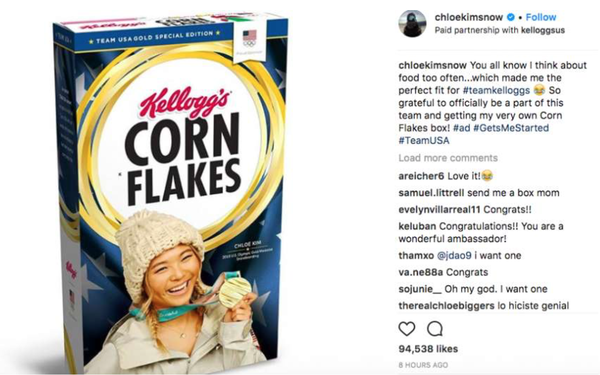
Members of “Team Kellogg’s” included U.S. women’s hockey team captain Meghan Duggan and snowboarding champ Kelly Clark. Team USA snowboarder Chloe Kim will be featured on Gold Medal edition boxes of Kellogg’s Corn Flakes, which sold out in a record 7 hours, according to SFGate.

Of the global Olympics partners, Samsung dominated in all three metrics: ad awareness, buzz and word of mouth. Besides a highly visible presence in PyeongChang’s Winter Village with its electronics and VR demonstrations, it received noticed for its “Do What You Can’t” TV campaign.

Both Toyota and Panasonic made strong gains, although ad awareness was considerably weaker for global partners than Team USA brands. Only four registered gains throughout the tournament: Panasonic, Samsung, Toyota and Bridgestone.


Social media

via MediaPost.com http://ift.tt/2nAOR8B

March 1, 2018 at 05:52AM

South Korean Chat App Becomes New Outlet for #MeToo Movement Technology


By REUTERS from NYT Technology http://ift.tt/2CdOvkc
via IFTTT