Thursday, September 27, 2018

Untapped Opportunity or Third Rail? Mastering the Social Healthcare Experience

Untapped Opportunity or Third Rail? Mastering the Social Healthcare Experience

https://ift.tt/2OkbiAc


Moderator Andrew Eklund, founder and CEO, Ciceron

Panelists
Katryn Gene, director of client services, Situation
Gary Kibel, partner, Davis & Gilbert LLP
Susan Walkman, CMO, Meals on Wheels

Andrew: We’re in a mature market with social. In early ’90s, AOL was my start. 2006-07 Facebook takes over world. Find ourselves at the precipice or nexus point of how we use networks to build brands. 

Susan: We went from using social for one or two purposes to how it blew up into one of the major things we do. Our version of March Madness, we had just sat through webinar on crisis management. Laughed to think about having a strategy if Trump attacks company. We were sleepy about it. Then new budget threatened to cut funding for Meals on Wheels. Out of nowhere, our phones ringing off hooks. Turned half organization into a PR response team. Really needed to up our game, take control of what was going on. Became a few weeks of long hours. Trial by fire.

Katryn: Rules of engagement helped us handle the Meals on Wheels crisis. Asking who are you always, sometimes and never on social. How are you going to interact, with whom, ignore? Tweeting for three days straight. Burst of attention, what to do with it. Expanding social media strategy. Social is at center point. 

Andrew: Gary, clients who have experienced something like this. Name where snakes, alligators are? 

Gary: This was more of a political PR issue. But with potential legal exposure, first response is to go on social media, say what’s happening. Benefit to be forthright but if you’re admitting maybe you had a problem, you want to speak with your counsel and what marketing wants you to say. In general, lot of regulation in healthcare. Say you have product authorized by FDA to treat symptom A. But you can’t talk about symptom B, you post on social, user says I took drug, it took care of issue B. You don’t want to click Like on that. Very careful. 

Andrew: Are you ever getting on the bat phone, responding quickly? Certain level of risk that’s available.

Gary: War room, legal is involved in that. What are rules of engagement? We can’t run every statement run by counsel. What are general rules. 

Andrew: Susan, did social become more important?

Susan: Before that happened, we couldn’t come up with enough content to feed our social channels. Now, we are fighting off departments. Everybody has seen different ways to use it. You can’t segment your audiences. We were able to deal with threat. We pulled together information to create advocacy campaign that generated a response to 99% of congress people. Largely because we fought it so hard. We’re now sophisticated enough to prioritize our messages to social media. 

Andrew: How do you in general resist temptation to have to respond to every negative comment?

Katryn: Followers denounce comments. In case of boss seeing tweet, hoping you’ve had conversation with them to ignore trolls. Ask them why they want it posted, response. Most of the time, we don’t have to respond. 

Gary: Is it a positive or negative statement. Can trigger legal complication. The reverse, adverse event reporting. If a consumer gives you notice that they had adverse effect, you have to tell the FDA. 

Susan: We are fortunate that we don’t get a lot of negative but if we do, it’s about the meals. If we see them, we’ll pass along to local program if there is a real issue. You can continue relationships on social. 

Andrew: How are you discovering your own brand stories through insights in social communities?

Susan: We do at times. Our engagement is never, it’s always part of a multidimensional look. Has to be on brand. Brand voice. Consistent. Everything we do focuses on “it’s more than a meal.” It’s the person coming to the door, social interaction. We get a lot of content from local members. We work with them to get content. 

Andrew: Playbook what brand needs to do on compliance. Cellphone video of client’s smile on face, socialization. What do they need to do to potentially use that story?

Gary: When we say “ad,” when you’re reposting content, it’s an ad. Do you have the right to use this information? When you’re on one platform, retweeting in the same platform, that’s okay. Low risk. But more likely if you grab it, put on your website, you need to get a release from individuals. 

Katryn: We’re always tracking sentiment. We see how people respond, what are they coming back with? Develop more content streams. What are people sharing with us. In Meals on Wheels, we’ll go check out groups who are active on social. Let’s amplify them and help tell the story. Hashtag: fans are using certain hashtag, give our stamp of approval on that. Taking something they made, giving credit. Moments can go by fast. Role of community manager not to be diminished. 

Gary: Also, one can invite public to give the stories to you. Easier to manage that.

Andrew: Multigenerational lines in the sand, FB skews older. My kids don’t go on FB, Snapchat’s where they are. How to align internal social literacy?

Susan: Volunteer recruitment has been our major push on social. 55+ and 18 to 25, split audience. We need to be out there because older people have time on their hands to volunteer, but we need younger people to do it. We’re stronger on FB and Twitter, trying to build up on Instagram. 

Video from this session will be available here tomorrow.


Social media

via MediaPost.com https://ift.tt/2nAOR8B

September 27, 2018 at 03:41PM

Heartstrings and Grassroots: Diversifying Be the Match's Donor Base

Heartstrings and Grassroots: Diversifying Be the Match's Donor Base

https://ift.tt/2ORnHsI


Amy Freese, director, strategic partnerships and multicultural growth, Be the Match (National Marrow Donor Program)

Challenge

Battling brand awareness, convincing people why they should be interested. We’re in throes of creating a lot of eye candy. Grassroots portion is a work in progress.

Mission is to save lives through cell therapy. Vision is to democratize it for all. 8.5 million on registry, 9,500 searches made in 2017; 6,100 transplants in 2017. Since inception 30 years ago, 86,000 transplants.

Provide people access to unrelated bone marrow transplants. 70% don’t have relative donor. Past year on average 18,000 searching consistently. 2/3 of the base can’t find a match. 

Many barriers, financial, some are related to insurance, primarily our registry base has a lack of finding a match based on your background. Black communities have 23% change, whites 77%. Lots of reasons, education, fact that we’re not directing our marketing that is effective for those lacking matches.

Execution

Objective going into 2019: Determine the optimal size and composition of the registry and launch campaign that expedites that level of quality participation.

Build Awareness
Education
Conversion

Focus group results: 

No parachuting in
Meet us where we are
Commit to the community
Educate and build trust

Based on those insights, evolving customized content. Focused on African Americans and then Hispanics. When it comes to healthcare in Latino community, it’s based on community roots. In African American communities, it’s about I’m gonna take care of my own self-care. In the API world, we are learning, give us qualitative, quantitiative results, we can determine how to go.

Putting together integrated campaigns. Combining partnerships with paid digital, PR, awareness events, influencers.

Our content, our patients who are searching, our donors and our transplant recipients that’s our content. There’s nothing else we need to say. A story well told. HBCU (Historically black college and universities) campaign foundation: Be present, provide education, be relevant. Last fall, focus groups, test piloting on campuses in spring. Now in full swing. Target audience is 18 to 34. College campuses are very important. We don’t want FAQs so we’re instilling creative components around myths and facts.

Videos are key. Digital platforms that they follow, what kind of campus it may be. Influencers, key in finding the right people.

Fantastic content, Brandon and Lauren, both donors. Staff members, ready to go. Have our mission at heart. Sheldon and Camille, both searching for five years. He was on GMA with us. Content is king.

Earned: media outreach, influencers and advocates, partnerships. Owned: organic social, constituent emails, web properties, programs, events for awareness and recruitment. Paid: digital media, paid social/OOH, paid partners.

Onsite activation and branding in plans with music, event activation and organic social ideas.

Results

400 to 500 inquires a day to 1,500 a day, give or take, due to paid strategies that we have. And OOH, between digital and it, it’s where our targets live.

Found 19,000 new donors

25% diversity, now at 34%


Social media

via MediaPost.com https://ift.tt/2nAOR8B

September 27, 2018 at 03:10PM

Nike's Kaepernick Campaign Scores With Key Audience: Urbanites

Nike's Kaepernick Campaign Scores With Key Audience: Urbanites

https://ift.tt/2NJ8PQp


This month, Nike unveiled its 30th anniversary “Just do It” ad campaign and product line featuring athlete Colin Kaepernick and all the drama surrounding his image.

In the ad, the NFL quarterback, known for starting the national anthem kneeling protests in 2016, appears with the phrase: “Believe in something. Even if it means sacrificing everything.” 

Consumers were quick to respond to the social-media ads. Some consumers posted photos of themselves destroying Nike products in protest, while others published posts loving the campaign. And still others asked brands to "steer clear of politics altogether," wrote lead Forrester analyst James McQuivey.

McQuivey believes Nike did “the right thing.”

It means “measuring the company's ability to emotionally connect with the customers most likely to want to continue to buy -- or increase their purchase of -- Nike products, McQuivey told Digital News Daily.

advertisement

advertisement

“That will translate into feelings toward the brand that are right for Nike,” he said. “Everybody gets what they want -- people have a deeper sense of purchase in their otherwise quotidian purchases, and the brand gets a sincerely given increased share of their wallet.”

Values-based appeals can pay off: In 2017, 52% of U.S. online adults said they actively consider company values when making a purchase, per Forrester.

Forrester estimates growth of Nike’s brand-related social-media chatter at eight-times within a day of the ad being released and 60% of that buzz stirred emotions, compared with less than half the week before. Media reports estimate it likely paid off in $163 million in free word-of-mouth marketing.

Although Forrester’s survey data notes many consumers feel negatively about the campaign, consumer energy remains high among the market that matters most to the brand, young urbanites with little military affiliation. Most are liberals.

Among its target audience, the campaign has resulted in higher levels of customer energy across all four of the dimensions that predict future engagement.

McQuivey writes: “For Nike, this is mission accomplished.”


Social media

via MediaPost.com https://ift.tt/2nAOR8B

September 27, 2018 at 01:38PM

D2C Upstarts In Healthcare: Disruption Or The Right Remedy?

D2C Upstarts In Healthcare: Disruption Or The Right Remedy?

https://ift.tt/2xIX02O


Learning From the D2C Upstarts

Moderator Beatriz Mallory, SVP, managing director, SensisHealth

Panelists
Mario Anglada, chief executive officer, Hoy Health LLC
Robert Borge, EVP, product and CMO, Blink Health
Samir Ghousheh, general manager of pharmacy, FSAstore.com

Beatriz: We’re looking at new entrants at existing points of care coming at it from a different way. 

Mario: We have simple mission targeted to providing everybody everywhere accessible affordable primary health. Built on access and patient engagement. Buy medications for anyone. In patient engagement, platforms one as a provider support, two if you are uninsured, you get kit at home for diabetes.

Robert: App for getting lowest provides on prescription meds. Buy online, pick up at one of 33,000 participating pharmacies in U.S. Own tech platform, bypassing middlemen. Our customers tend to be high out of pocket costs, high copay.

Samir: Web properties. Goal is to educate consumers about FSAs and HSAs, many don’t know how to use them. Out sites help clarify that, put messagin out there to help consumers make decisions. You can learn about them and we have landing spots to buy products on the site. Sunscreen is covered.

Beatriz: Organization here aren’t “disrupters,” really looking at entrants. Different approach.

Samir: I don’t want to be disrupting healthcare. Find better ways to deliver it, yes. I see tech, lot of advancements in delivery to complement existing models. I don’t see an Uber of healthcare. Doctors using genetics to deliver better treatments. Ways to drive better outcomes. We’re a consumer facing company trying to simplify messaging around healthcare. Drive more preventive treatments. Making healthcare more consumer-centric. 

Robert: Very refreshing perspective, so much hype around tech companies. Uber has faced incumbent challenges wherever they’ve gone. Brought market forces to the industry. Lessons for anyone looking at healthcare and technology. We feel extremely strongly that disruption in the classic definition, we are unambiguously disrupting. Prescription drugs one part of economy that is consumer transaction. Ecommerce has disrupted major players. This category is remarkably opaque. Travel, brokerage, music where internet economy has come in, middlemen have disappeared. 

Mario: Our approach is incremental disruption. Price and transparency. We want to be sure we’re embedded into the incumbents to help them navigate the customer relationship. Working within system to understand, to help, let’s take it from a different angle. Use technology as an enabler. Having a one to one relationship with patient is impossible.

Beatriz: Are your target consumers a new generation of consumers or are they healthcare consumers with digital ability?

Robert: From behavior standpoint, yes. Trends pushing consumerization of healthcare. Innovation is all over. Countless number of companies trying to bring transparency. Kind of like water. When the internet economy makes its way in, it’s gonna find its way. It’s gonna cross demo and social graphic balances.

Mario: Let’s bring underserved consumers, deflect cost where it matters. Bringing in new type of consumer who didn’t have access to system. If you want to come buy medications from us, we’ll allow you. Creating a system that is parallel to traditional model.

Samir: From a new consumer perspective, you think patients. Now we say consumer, customer. People’s habits are changing, traditional ways of delivery is changing. People are shopping for options. Trying to find if it makes sense to use insurance to get MRI or look for different, cheaper option. 

Beatriz: Segmentation, people with high out of pockets, non or underinsured, can’t hit co-pay. How you affect segmentation for your properties?

Samir: We partner directly with TPAs, demonstrate benefit to employees. Work with employers to let them know how healthcare has changed. Let us help you help your employees with understanding how to plan for FSA, HSA space. Let us help them understand where they can spend those dollars and what they can spell them on. We’re serving a 20-something to high 50-something population. Work force in general, female ratio is growing. 60% of customers we serve are female. They’re the care takers. 

Mario: We start with idea that we build everything for a third grade education level. Focus on Hispanics is because of need but also opportunity. A lot of growth in next 25 years comes from Hispanic consumer. We do partnerships, a trade union, a hospital system, a retailer, a supermarket, people in community, church. Important to have the aha moment. 

Robert: Humans first. We want to lower prescription drug prices, philosophically contradictory to segmentation but we approach marketing fast iteration, A/B experiments, investment in measurement. Segmentation flows out of that. Blink Health Nation has fortune to have patients and providers spread word actively for us. Thousands send us videos to tell their stories about what having lower prices has done for their families and lives. Gives us great tailwinds from customer acquisition standpoint. 

Video from this session will be available here tomorrow.


Social media

via MediaPost.com https://ift.tt/2nAOR8B

September 27, 2018 at 12:41PM

Paging Dr. Data: Driving Better Relationships with Smarter Segmentation

Paging Dr. Data: Driving Better Relationships with Smarter Segmentation

https://ift.tt/2NHjQSi


Moderator Hans Kaspersetz, president and chief strategist, Arteric

Panelists
Gabrielle Bedewi, chief analytics officers, Butler/Till
Brian Deffaa, CMO, LifeBridge Health
Justin Freid, EVP, managing director, CMI/Compas
Shonel Morrison, associate media director, AstraZeneca

Hans: How to create life-changing experiences for people. Number of challenges. Few years ago we would spend time talking about things we couldn’t do yet. On data, personalization, we’re at that stage again. Privacy, siloing issues. Agree? Disagree?

Justin: We’ve gotten over a big hump. In pharma space there was a lot of pushback. There are people internally that understand marketing, data. Great to have internal advocate to speak to regulatory. Now, most of pharma companies over that hump. Personalized messaging. We’re definitely taking that next step.

Shonel: working with regulatory partners, get them on your side, work on other folks later. People are more than just a patient, they’re just like us. Shift in terms of healthcare, personalization and getting smarter with the way we advertise.

Gabrielle: In healthcare, a lot of B2B, only when member was making choice with plans, that necessitated the turn from sales to marketing. They see importance of seeing member journey, connecting with them in case management, integrate all information, reaching them, truly understadding member’s needs. Dependency on data. Insurance companies building data hubs, feeding marketing, changing from sales mentality.

Brian: Through provider lens, they look at patient and looking to understand the journey but they don’t know how to activate it. Lagging and deficient in certain areas. Patient presents, healed, sent away. We’re trying to move to journey that never ends. We start developing real relationship, they trust our quality, the experience. That wholistic view is something that organizations like mine, we’re just starting to cross that threshold.

Hans: CRM and other platforms promises 360-degree view of customers, patients. What are the challenges?

Shonel: inconsistent capture of data. Having systems that are at our disposal but lack of awareness from marketers that they exist. Purchasing tech aren’t speaking to marketers to connected that gap. 

Justin: Before we get to CRM, who’s our patient segmentation. Attitudes. Issue: we come up with attitudinal segments, but none is actionable from a marketing perspective. Especially in healthcare space, careful with HIPAA compliance. Getting involved earlier on in the process, making sure media is a big part of that. If we can’t target them, is it really useful? 

Hans: One of the things we’ve done is analysis on verbatim search queries, align with attitudinal profiles. Build content based on language they use. Lot more content. FAQ page. Now we build 5, 10 version of FAQ page, each one based on how demo asked the question. We see different content placed in front of different audience based on search. Converts at a higher rate.

Justin: Outside of healthcare, search queries give you an inordinate amount of information. Social listening, people talk about their health. A gold mine. Helps us with targeting.

Brian: Silos, data accuracy. We’ve tried to ID who owns what. Some IT proprietary. Assigned owners, metrics to establish a dashboard, get on same page. Our communications objectives. Prior, that wasn’t happening. No strategy. Pull IT, marketing, patient experts together, where are our metrics, realign resources to make it happen. Hospitals, doctors lack a lot of coordination, structure. Nearest, dearest next step.

Gabrielle: Developing segmentation, I ask what is the objective of the insight. How will you act on it? Attitudinal, primary resource, why people behave differently, you can’t assign a person to a segment on your database. Behavioral segmentation helps you, but sometimes you don’t understand the why. How to integrate? Syndicated segmentation is the link between attitudinal and behavioral. Segmentation is a strategic initiative. 

Brian: Question becomes how to do that, internal or outsource. We’re bringing in a digital first agency. Start with strong baseline, then help us where our core segments are, competencies. Competitive advantage, leverage against that.

Hans: Any practical strategies for breaking down silos, finding data, get access?

Justin: Benefits to work with agencies. Often in position to see multiple approaches to data management. This is what should be done, this is what we need. Partners can help guide the conversation. Often, we’ll come with data that show when you do this, it equals this. 

Brian: Our management knew what they didn’t know. They wanted someone who knew what good could look like, this is how you get there. Our senior leaders in IT, CX get it. Anxious for somebody to stitch disparate pieces together. Creating picture of the future, laying in those tactical points to get there. Paint by numbers.

Shonel: Understanding how physicians like to get information, lays groundwork for media plans, budget, content, channels. When there is a lack of internal team to help with things like this, we rely on our agencies. We rely a lot on analytics partners. Help us make informed decisions on media plans and how we go to market.

Hans: Privacy concerns?

Gabrielle: At healthcare company, became friends with chief security officer. Understanding the space and reason that privacy laws are in place. I don’t need the namer of the patient, just need to understand behavior. External data providers can give you the external info that you need. There are ways to get the information, be cognizant of how you are using it. Close relationship with security officer. Web scraping, a tech that helps you track words that you can analyze on back end. There are some regulations about that now. 

Shonel: With Facebook and GDPR, forced us to take a hard look at our cookie policies were, privacy policy on website, transparent. We consulted with our privacy officer to make sure we were covered. Consult with legal partners early and often. Seat at the table. Having them bought into what you’re trying to do is helpful.

Brian: More about understanding condition and providing additional value to person. We keep a firewall to avoid creepiness factor. We don’t want to speak specifically to their condition.

Video from this session will be available here tomorrow.


Social media

via MediaPost.com https://ift.tt/2nAOR8B

September 27, 2018 at 11:48AM

How Authenticity and Wit Hit a Nerve and Solved a Crisis

How Authenticity and Wit Hit a Nerve and Solved a Crisis

https://ift.tt/2DCdI9l


Proof and Blue Chickens: How Authenticity and Wit Hit a Nerve and Solved a Crisis

Cindy Donohoe, EVP, CMO, Highmark Health

The Challenge

Allegheny Health Network wanted to demonstrate that it had as good quality as its bigger competitor in Pittsburgh. Some in the company suggested just saying that we’re No. 1! But, said Cindy Donohoe, that couldn’t be it. Everyone’s No. 1. Besides, people don’t talk about places being No. 1. They talk about what they can do know. Their own outcome, the people. They want innovation but in hands of a doctor who listens. So, how do you change someone’s mind?

The Execution

We decided to be big, bold and fast. Donor of Detroit came up with #LivingProof to show evidence of how we’ve changed people’s lives.

Effies No. America, gold, went to two campaigns, to be up there with Mars, Unilever, very proud. But we really learned a ton. With both campaign, deep core insight, raw, authrentic emotion, tears and laughter, getting effective results.

Allegheny Health Network, challenge: how to demo we have as good quality as bigger competitor. Just tell them we’re No. 1! But the claim couldn’t be it. Everyone’s No. 1. People don’t talk about No. 1. They talk about what they can do know. Their own outcome, the people. They want innovation but in hands of a doctor who listens. So, how do you change someone’s mind?

Big, bold and fast. #LivingProof by Donor of Detroit. Evidence of how we’ve changed people’s lives.

  • Give them an experience. 
  • Be insistent and persistent. 
  • Hear it from friends.

We set out to tell stories. It was cool to be able to show you life as it unfolds. A day in the health system. Lots and lots of stories in a real way. More like a documentary. Literally showing what’s happening right now. Capture and let people be voyeurs. To make it more difficult, we’re gonna do 30 in 30 days. Told press. Started in June, on air mid-August. Releasing to TV stations as ad. Best part about it was authenticity. 

You can imagine the variety of stories that we had. All authentic. some are dramatic, touching, this was a surround sound message. Not just 30 TV commercials, also on the news ticker on morning news, on radio, ton of digital. Every aspect we could do.

We had to educate the physicians that they aren’t the heroes anymore. What we did on social, voices came from consumers. People sharing stories about how they were saved. Did have a viral effect. 

Set about creating experiences: big bold fast. Larger than life, built world’s largest arm cast, 35 feet long, we had mended 26,000 bones that prior year. Invited those people to come sign the cast. Pirates catcher was one; made it a media event. What to do with cast? Sawed it in half, put it up on a billboard. Got an award for unique OOH.

Delivering babies. We deliver 6,500 a year. Got 6,500 storks, took them to races, invited parents to come by, sign one, take photos, share online. Great way to get point across about how big we were. We built the largest game of Operation. Gave out red noses that lit up. Took it to events, gave kids lab coats have doctors compete with them. 

Social: first time ever we got more volume organically than from paid. We had postpartum depression spot got shared virally. Surprising thing about this is that it changed our company, our culture, came at a time when the system and health plan were coming together. Reminded us that it’s not about us, it’s about them. Highlighted in our annual Report. 

Marketing was ingrained. Our production costs were $50K per commercial. Content now is digestible and consumable so we’ve had to learn how long a story can last. Rip through content faster. Agile practices, changed the way we do our work. To close this campaign, the retail side, we said, give us same-day appointments, offer for all specialities. Created “Call in by AM, be in by PM” so gratifying, patient last week in a lot of pain, she got one of our direct mailers at home, called, diagnosed, got meds. Such an impact.

We said, Let’s own the morning. Sleeves around coffee cups, laundry hangers same day and now doctor’s appointment, too. Wrapped buses, we bought 8 exam chairs (took stirrups out), wrapped them during a race, plop outside the bus stop, town square.

Blue Hen campaign in Delaware, different situation, leading provider in Delaware. Decided to have two health plans in the year. Our product was going to be more expensive, we weren’t allowed to communicate with people. 90 days. How do we get core insight. Delawareans love their blue hen, state bird, University of Delaware has the Fighting Blue Hens, tap into loyalty to remind people of their loyalty to Highmark, to Blue [Cross]. No ruffled feathers. Other retail things, lot of similarities, no paid actors, authentic, super simple.

Results

  • 18 points uplift in unaided awareness. Consideration went up 20 points when we launched. Most important metric is about quality. After two years, only 2 points behind in difference with competitor.
  • Inpatient volume rose1.8%, new appointments went from 17% to 34% and have maintained that.
  • Brand favorability rose in 73% of the population.
  • Blue Hen campaign achieved retention goals. Got 10,000 people to switch over.


Social media

via MediaPost.com https://ift.tt/2nAOR8B

September 27, 2018 at 10:55AM

New For Fall: On CBS, God Seeks Friends On Facebook

New For Fall: On CBS, God Seeks Friends On Facebook

https://ift.tt/2xK3y0W

Many might consider social media to be a decidedly godless realm, but a new drama series on CBS posits that it is anything but.

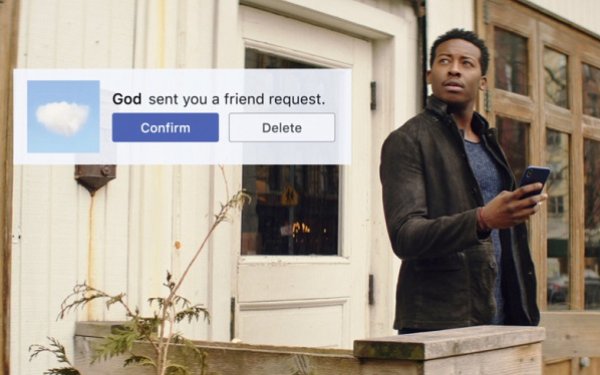
In this show titled “God Friended Me” (premiering Sunday night on CBS), the Lord appears to have adopted Facebook as a platform for promoting his good works.

In a modern-day twist on the ’70s movie “Oh, God!,” the Almighty's appointed messenger in this show is a young man living in New York City who assumes the role played by John Denver in the old movie.

Like the Denver character, this young man -- played by Brandon Micheal Hall (seen in the photo above receiving a Facebook friend request from God) -- is a skeptic who cannot understand why God has chosen him as his earthly emissary. Nor can he accept it, at least not at first.

advertisement

advertisement

The young man, Miles, even has a podcast called “The Millennial Prophet” where he preaches the gospel of atheism. This point of view puts Miles at odds with his father, who happens to be a minister (he is played by Joe Morton).

In His friend requests, the God in “God Friended Me” is nothing if not persistent. The requests come so frequently that Miles eventually accepts one of them. After that, “God” recommends that Miles friend a couple of other people.

As it turns out, these people have various troubles for which Miles might provide timely intervention.

And that’s the show. Certainly, these friend requests from someone or something claiming to be God do not immediately cause Miles to convert from his atheism. Part of the show’s storyline is his ongoing skepticism.

Despite the incredible coincidences he begins to experience in his life in the series premiere, he continues to believe that someone is pranking him.

“God Friended Me” is a feelgood show with a foundation built on social media. As such, it seems designed chiefly to appeal to those who use social media the most.

In a world where many might perceive social media as hardly a force for good in the world, especially these days, this show offers a scenario in which social media possesses an untapped potential for making the world a better place.

The challenge for this show will be to try and make believers out of social media skeptics.

“God Friended Me” premieres Sunday night (September 30) at 8 Eastern (depending on NFL football overrun) on CBS.


Social media

via MediaPost.com https://ift.tt/2nAOR8B

September 27, 2018 at 10:55AM